CHANGING DIPLOMACY
Former British diplomat and Professor of Practice
in Diplomacy at SOAS University of London,
Nicholas Westcott, explains that today’s diplomats
need to re-learn some of the old arts and adapt them
to our present times

Diplomacy appears to be going not so much back to the future as forward to the past. The echoes of the 1930s are getting louder – a decade that did not end well.
Liberals are feeling lost, their assumptions about the world crumbling: domestic politics is polarising; autocrats are using the latest technology – then radio, now social media – to spread fear and loathing; territorial expansion is back on the agenda; and international rules are being broken with apparent impunity.
Perhaps diplomats had become too comfortable. Most spent their time negotiating trade and cultural agreements, regulatory standards, development programmes and financing packages rather than matters of war and peace. The most difficult issues have often been those related to migration: controlling borders and negotiating return agreements.
But fundamentally diplomacy has always been about the avoidance of war, and that is once again the primary focus in Europe and Asia as much as in the Middle East and Africa. Hard power, in terms of divisions and drones, sanctions and subversion, is again at the heart of diplomacy. So we need to re-learn some of the old arts and adapt them to our present times. The world today is markedly different from how it was in 1939. So diplomats need to develop new skills as well as revive old ones, as I have explained in a new book, How to be a Diplomat.
Many of the basic skills of diplomacy nevertheless remain valid. We still need diplomats who are intelligent, articulate, curious and creative, able to learn political as well as foreign languages so that they can understand the real meaning of what the other side is saying, often behind the words they speak.
The traditional practices of diplomatic business will also remain in place. Ambassadors will still be sent and received, national day receptions and diplomatic dinners will still be held (by those that can afford them), ministerial visits will still go back and forth, and the travelling circus of international meetings, summits and conferences will continue – though perhaps less frenetically as the money that fuels them runs low.
The structures of multilateralism will also continue, though they risk being hollowed out. National governments have got used to relying on the Law of the Sea, on rules governing global commerce and global communications, which they will not want to lose. The UN and many of its agencies will probably remain, though their proactive role may be severely constrained by reduced funding and a lack of agreement on what it should do.
Fundamentally diplomacy has always been about the avoidance of war, and that is once again the primary focus in Europe and Asia as much as in the Middle East and Africa
But significant changes are taking place.
More diplomacy is being done bilaterally, bypassing the multilateral structures that have been used as channels up to now. The EU’s institutional structures are probably sufficiently robust to survive. But elsewhere, it is clear that Trump disdains both alliances and multilateral organisations, and prefers to deploy the full weight of US power bilaterally on a weaker partner. And where he leads, others follow. China publicly champions the multilateral system, but on its own terms, not those of ‘the West.’ Middle powers like India, Turkey and the Gulf states are all looking to cut bilateral deals to their own advantage with their near neighbours.
But such deals are increasingly cut not by ambassadors but by envoys, close advisers to the leaders who settle issues directly between themselves. Many US ambassadors (or chargés d’affaires, as many of Trump’s appointments still await Senate approval) have no idea what Steve Witkoff is negotiating on behalf of the President. Direct access to the leader rather than through traditional diplomatic channels will increasingly be the way bilateral relations are conducted. So getting close to your leader will be even more important for the aspiring diplomat.
Negotiations risk becoming more entangled. It is one thing to cut a deal, it is another to deliver it. Already some proclaimed ‘peace deals’ – between the DRC and Rwanda, India and Pakistan, or in Sudan – are failing because no proper implementation mechanism has been included. Wars are easy to start and hard to end. Making peace is a lengthy and painstaking process, and half-baked deals often come to grief, compounding rather than solving the problem. The Minsk Agreement temporarily stopped the fighting in Ukraine but failed to create a lasting peace. The next peace deal for Ukraine will need to be significantly more robust.
Economic warfare, through sanctions and tariffs, is also playing a growing role in diplomacy. Diplomats therefore need to hone their economic skills, and ministries of trade need to operate ever more closely with foreign ministries. In a transactional world, partners will more frequently want to see results in terms of cash or business profits, not just in friendly relations. So diplomats will need to carry a (metaphorical) roll of dollars in one pocket as well as a gun in the other.
So relative hard power will be crucial – as Trump has been making clear to European partners. The diplomat will therefore need a keen appreciation of what is backing up his or her words and know when and how to deploy pressure or inducement. Arguments based on international law or norms will carry less weight. Stalin famously asked, ‘And how many divisions has the Pope?’ when the Vatican’s opinion on an issue was raised at the Potsdam conference. Both Trump and Putin take a similar approach.
But public opinion still matters, and is becoming a more contested arena as China, Russia, and ‘national conservatives’ all mobilise social media to weaken ‘the West’ and its social and political norms. Diplomats will have to become – even more than now – masters of the media and use every available means to get their message across. As discussed in the book, social media poses a particular challenge because it thrives on simplicity, brevity and controversy – difficult when dealing with diplomatic questions that are often complex and delicate. Nevertheless, this is the virtual world people now live in, and diplomats have to be there.
It also makes secret diplomacy ever harder to do. Information can leak out at any moment, and negotiating in public encourages politicians to play to the gallery rather than fix the problem. But doing the deals that are needed can often only be done behind closed doors. So thicker doors may be needed.
Many of these skills are not new. We have just lost the habit of using them. So young dogs may have to learn some old tricks.
Wars are easy to start and hard to end. Making peace is a lengthy and painstaking process, and half-baked deals often come to grief, compounding rather than solving the problem.
Nicholas Westcott is Professor of Practice in Diplomacy at SOAS University of London and a former British and European diplomat. He joined the Foreign and Commonwealth Office in 1982, and served in Brussels, Washington and Tanzania, and latterly, as British High Commissioner in Ghana and Ambassador to Côte d’Ivoire, Burkina Faso, Togo and Niger.
How to be a Diplomat, Nicholas Westcott
With the international system entering a period of extreme flux, diplomacy has never been more important and the role of a diplomat more complex. This book provides an indispensable guide to what a diplomat does, why, and how.
Drawing on the literature and on decades of experience, the book explores what it means to be a diplomat – in all ways and all walks of life as well as in government. It examines with wit, wisdom and practical examples how diplomacy works, how to negotiate successfully, how to deal with a crisis and how to respond to the impact of social media; why protocol and rules still matter; how to manage a mission; and how to cope with the peripatetic way of life. Finally, it discusses what it means to come home after it all.
The book focusses particularly on how diplomats should adapt to the current fast-changing geopolitical and technological contexts. These will require more diplomacy, and more diplomats, not less if the world is to avoid being dragged back into conflict.

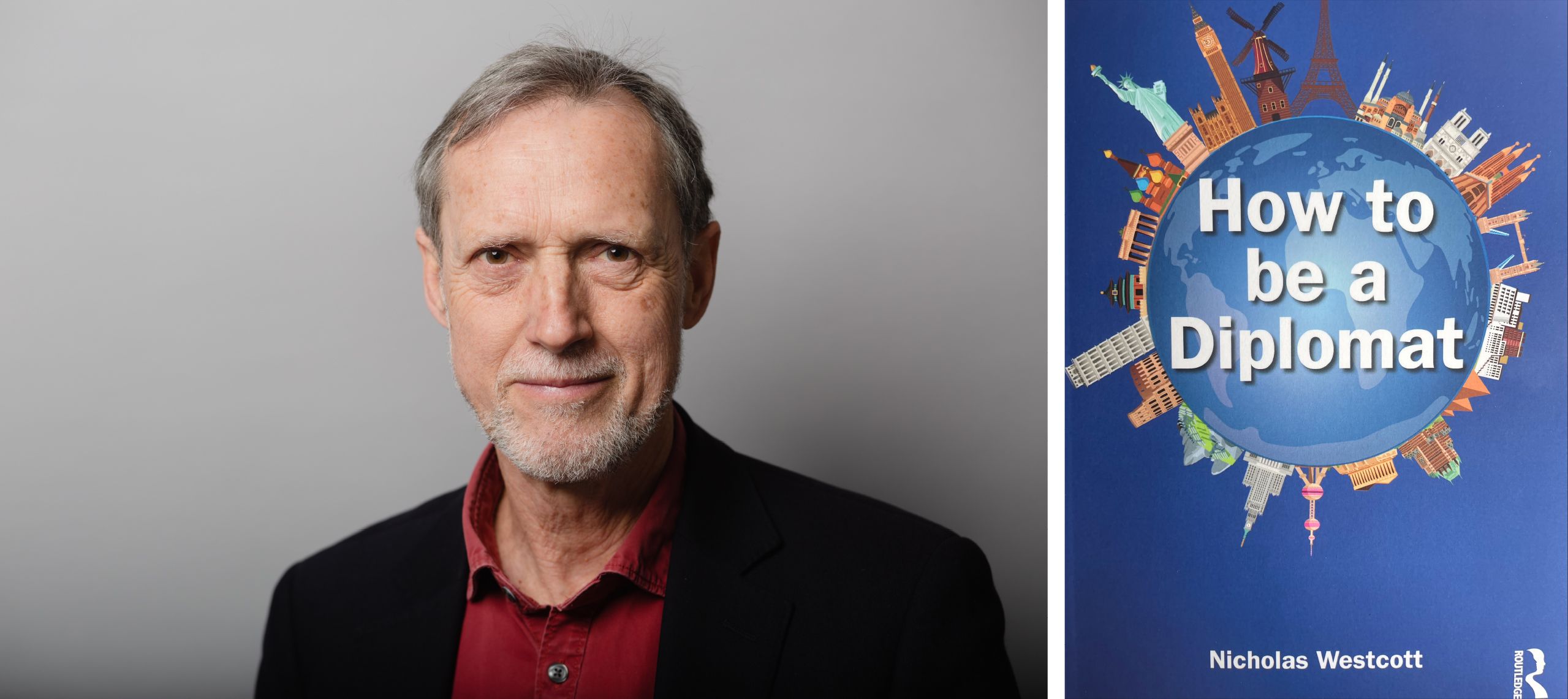
Available from Routledge, with an exclusive 20% discount: just enter the code 25AFLY3 before purchase.
 Built with Shorthand