
His Excellency
Ashraf Swelam
Ambassador of Egypt
to the United Kingdom
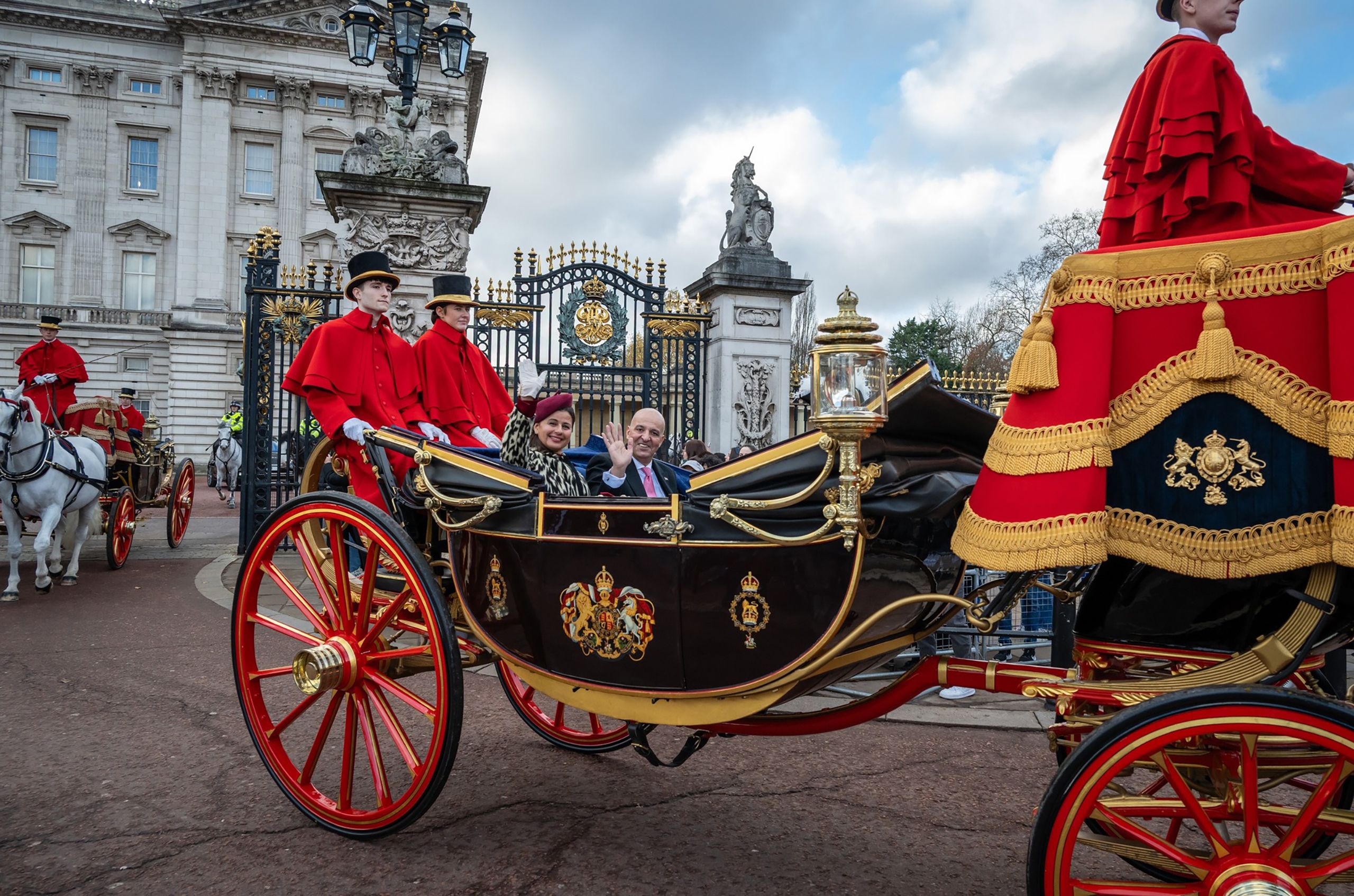

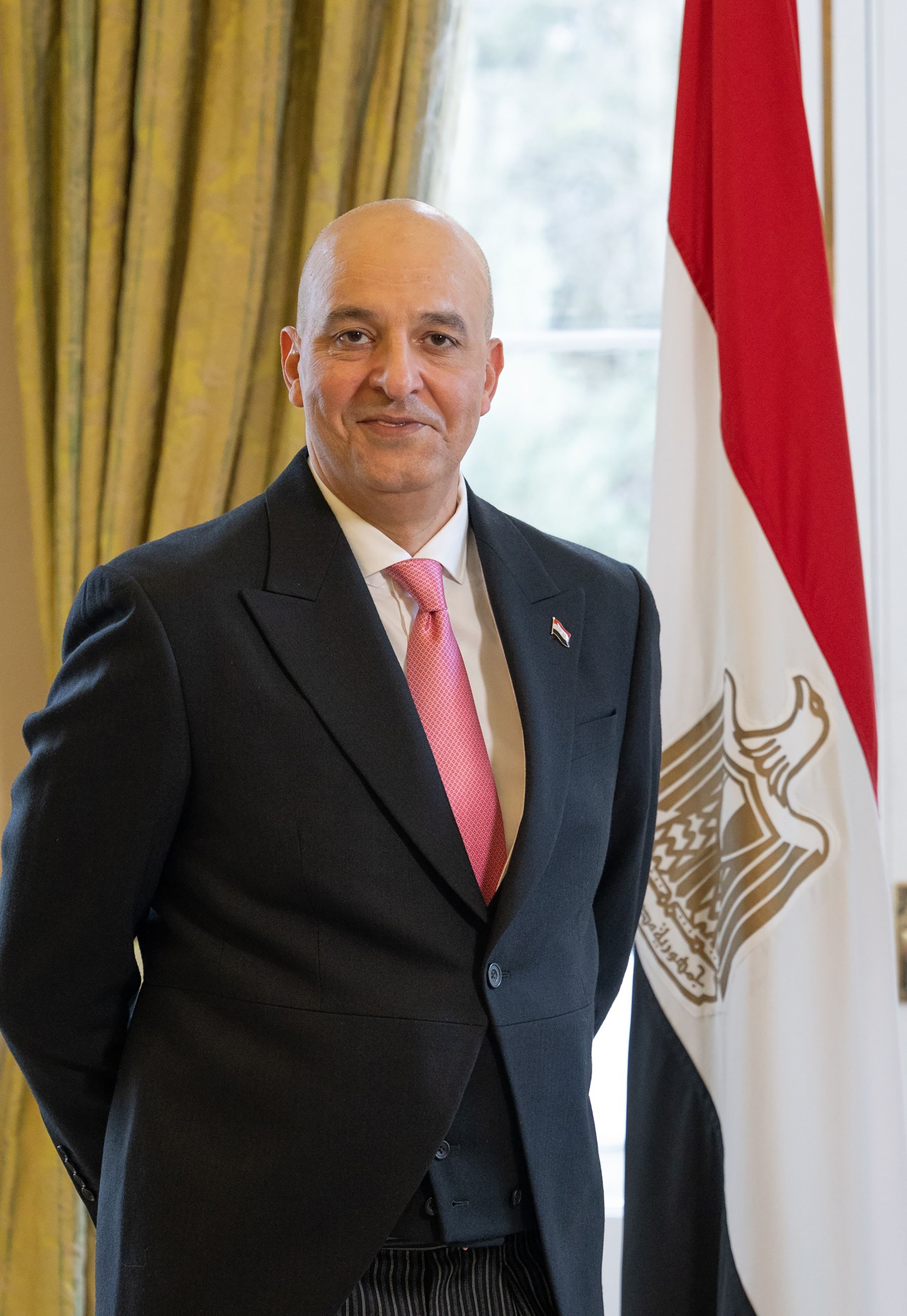
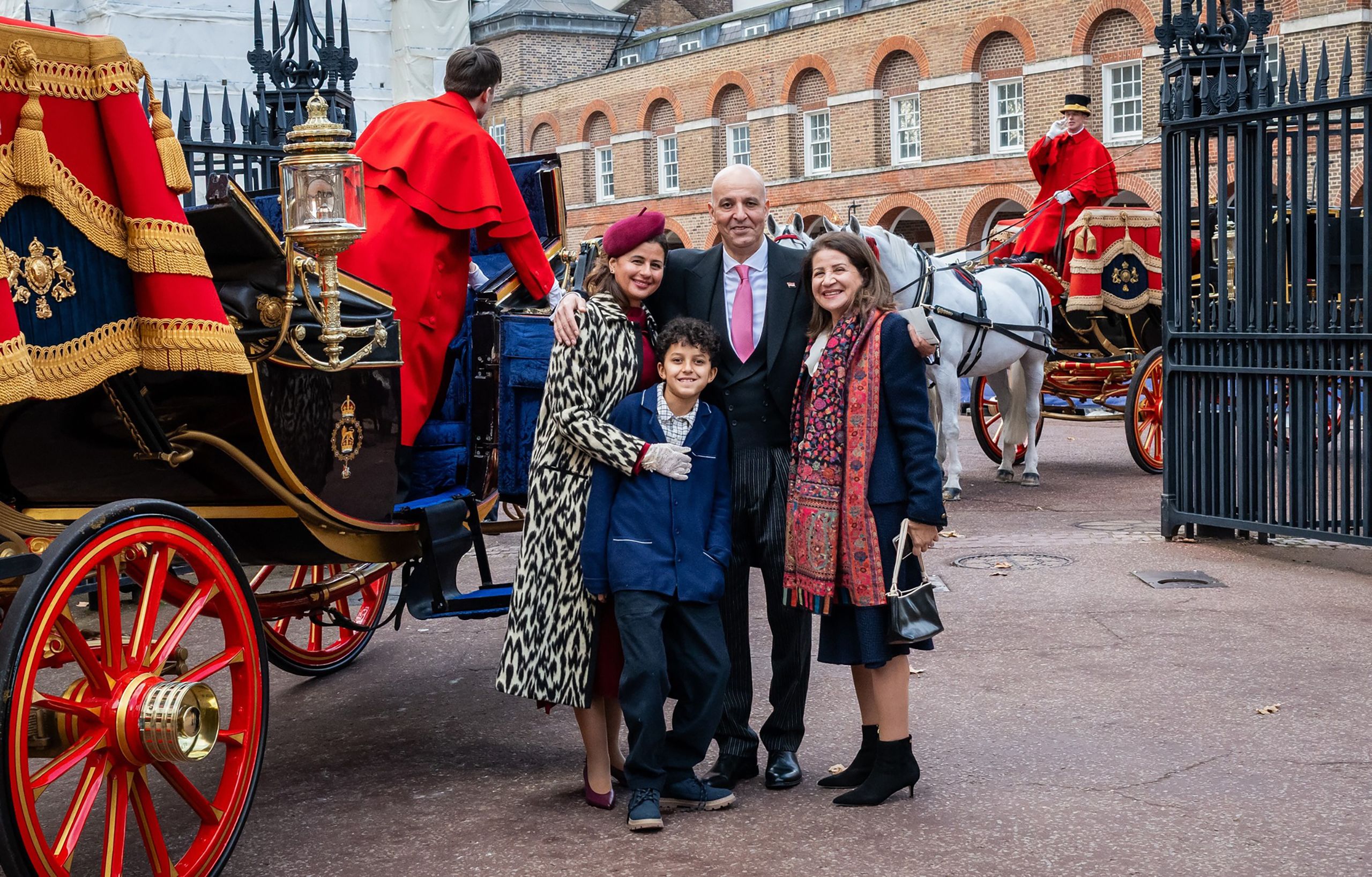
When His Excellency Ashraf Swelam arrived in London back in September, he was greeted not by the grey skies often associated with the British capital, but by unexpected sunshine. “I arrived… to what was surprisingly a sunny and warm London,” he reflects. For an envoy whose career has spanned nearly three decades and who has travelled to 55 countries, first impressions matter—but so too does context. London is not entirely new territory for the Ambassador: he completed a master’s degree at Warwick University in 1998. Yet this posting marks a significant personal and professional milestone, as it is the first time his family has accompanied him on an overseas assignment.
“London is a beautiful city, with lots to do,” he says, noting how quickly each family member has found their own rhythm. Beyond the weather and the city’s cultural offerings, the Ambassador sees London as a global crossroads. “If you like arts, history, sports, a discussion about politics – both domestic and international – you can find them in London. So, in that sense, London has already become one of my favourite cities.”
From Early Exposure to Diplomatic Life
Ambassador Swelam’s path to diplomacy was not preordained. Raised in an upper, middle-class family in Egypt, expectations were conventional. “My parents had set ideas about what they wanted their children’s careers to look like. I was going to become the engineer, my brother a doctor.” The turning point came in 1988, when his father was appointed to Egypt’s Embassy in Belgrade, at a time when Yugoslavia was still intact. “Aged 16, this was my introduction to diplomatic life, and my destiny changed.”
Academic interests subsequently developed out of lived experience. Economics and political science came first, followed by law after he joined the Ministry of Foreign Affairs. Applying to the Ministry was highly competitive, but his success was decisive. “I came top of my class, which I took as a reaffirmation.”
Africa at the Centre of Egypt’s Diplomatic Engagement
From 2013 until his arrival in London, Ambassador Swelam’s professional focus was almost entirely on Africa. His roles included serving as Egypt’s Assistant Minister of Foreign Affairs for African Organisations and Communities (2022-2025) and before that as Egypt’s Ambassador to Uganda (2020-2022), and as Director General of the Cairo International Center for Conflict Resolution, Peacekeeping and Peacebuilding (CCCPA). Reflecting on Egypt’s historical role, he recalls that “back in the 1950s and 1960s, the biggest challenge facing the entire African continent was to get rid of colonialism,” a period during which Egypt played a key role in supporting African independence movements.
Today, he identifies two overarching challenges facing the continent. The first is the complex challenges to peace and security. “Africa, unfortunately, is still home to many of the major conflicts taking place around the world. Almost 70 per cent of the UN Security Council’s time is spent on African issues.” These challenges are compounded by terrorism, forced displacement, illegal migration, and climate change. The objective, he stresses, must be not merely to manage conflict, but “to end conflicts when they start and to hopefully prevent them from happening in the first place.”
The second challenge—and opportunity—is development. “Africa is a big continent, and each country is unique. And the one thing that they each share is potential.” With rapid population growth, he notes that “between now and 2050, one of every four people walking the planet will be African.” Whether this demographic shift becomes a dividend or a destabilising factor depends on translating potential into opportunity. “So, it is in our hands whether we can turn that opportunity into a real one.”
Lessons from Conflict Resolution and Peacebuilding
Seven years leading the Cairo Centre for Conflict Resolution, Peacekeeping, and Peacebuilding have left a deep imprint on the Ambassador’s thinking. The first lesson, he says, is the centrality of the state. “The role of the central state cannot be emphasised enough.” Where state institutions collapse, rebuilding becomes exponentially harder.
Equally important is national ownership. External templates imposed by global or regional powers rarely succeed. “If it’s not nationally determined, if it’s not nationally driven, if it’s not nationally planned, and if it’s not nationally funded, then it doesn’t work.”
Finally, he calls for a paradigm shift towards prevention. “It is much more cost effective to focus on the prevention of conflict, rather than to deal with the consequences of conflicts after they have already begun.” Supporting state institutions to plan for development and peace, he argues, offers the most sustainable path forward. “That’s why we launched the Aswan Forum for Sustainable Peace and Development,” he added.
Constitution-Making and the Human Dimension of Diplomacy
One of the most formative experiences of Ambassador Swelam’s career was serving as Lead Counsel in drafting Egypt’s Constitution following the 2013 revolution. “That was a life-changing experience,” he says. Unlike traditional diplomatic work, constitution-making required engagement with Egyptians “from all walks of life, and from all over the country.”
The process reshaped his understanding of foreign policy. “Foreign policy at the end of the day is an extension of domestic politics.” Its success depends on tangible outcomes for citizens—improving livelihoods and well-being. “It was interesting to observe that the livelihood of a farmer working 1,000km from Cairo is dependent on the work of Egyptian foreign policy.”



Elevating the Egypt–UK Relationship
Ambassador Swelam arrives in London at what he describes as an “opportune time.” Egypt and the UK are in discussions to elevate their relationship to a Strategic Partnership—the highest level of bilateral cooperation for Egypt. This builds on a “very solid foundation” encompassing trade, investment, education, tourism, and close coordination on regional and global issues, including Palestine, Sudan, and the Horn of Africa.
A forthcoming visit to Egypt by UK Prime Minister Keir Starmer is expected to formalise the partnership, alongside a major British–Egyptian investment conference. Britain is currently the second-largest investor in Egypt, with accumulated investments of £22 billion. “We’re looking to solidify what exists right now… and explore the frontiers of opportunities that exist in new areas, like working together on climate change or renewable energy.”
Culture, Education, and Soft Power
Cultural diplomacy forms a central pillar of the Ambassador’s approach. He has already overseen successful concerts by Egyptian artists in London and a high-profile parallel event at The British Museum marking the opening of the Grand Egyptian Museum in Cairo. “I cannot speak highly enough of the generosity and professionalism of the team at the British Museum,” he notes, describing a reception held among Egyptian artefacts. “These are the kind of events that I am interested in continuing to organise.”
Post-Brexit Opportunities
In the post-Brexit environment, Ambassador Swelam sees new avenues for cooperation. The UK’s renewed focus on industrial policy aligns with Egypt’s strengths, particularly in renewable energy. “Renewable energy is an area in which in Egypt couldn’t be stronger, in terms of wind and solar,” he says, pointing to significant potential for joint investment.
Advice to the Next Generation
Reflecting on nearly 30 years in diplomacy, the Ambassador emphasises lifelong learning. Two formative experiences—the Bucerius Summer School on Global Governance and the World Fellows Programme at Yale University—broadened his perspective beyond traditional diplomatic frameworks. “I soon realised that there’s so much that I don’t know… because I was always looking at issues as a diplomat, rather than from other points of view.”
His advice to young diplomats is clear: “Keep yourself, your brain, your heart, and your mind open to new experiences. That is a guaranteed way that you will continue to learn.”
Navigating a Complex Regional Environment
Asked about Egypt’s greatest diplomatic challenge, Ambassador Swelam describes a “perfect storm” of regional instability—from Gaza to Libya, Sudan, and the Horn of Africa. Yet he underscores Egypt’s resilience. “Despite all of these difficulties, Egypt continues, not only to survive, but to build a magnificent museum. At a time when there is so much suffering and pain in the region and around the world, Egypt continues to progress with determination to provide opportunities for its younger generation.”
Personal Milestones
Among the Ambassador’s most memorable moments are deeply personal ones, like the birth of his son. It placed his career, he says, in a larger context—family, choice, and responsibility. Outside the diplomatic arena, he enjoys playing football with his son, united by their shared admiration for Mohamed Salah, and exploring London’s vibrant cultural life.
Together, these reflections paint a portrait of a diplomat shaped by institutions, openness, and an enduring belief in engagement—nationally, regionally, and globally.
 Built with Shorthand